Is burning fossil fuels the number one cause of global warming? Dunno. Not really sure at all, because, frankly, there is a lot of stuff going on on the planet. Ms Earth has a nasty habit of warming and cooling, all by herself.
Is global warming the number one danger civilization is facing? I say no way Jose. I say the most clear and present danger is the current capitalist, corporate fascism. Just my opinion. But since you’re here, I’ll tell you why.
One. The present corporate-capitalism is a borg-like machine with one purpose: move money up. Forests are only valuable to this machine when they are broken into pieces and sold. Humans only valuable for their labor-production-profit capacity or the money that can be taken from their pockets. Tigers are valued by the pelt or zoo revenue. To the borg, society is a means to pump money up into high pockets. Nothing else. The borg cannot smell or eat grandma’s cookies, but it can brand and market and distribute them. The present borg system disrespects nature. Nature is invisible to it. So is society. So are you. So am I. It cannot see us. It cannot see grandma and children, nor smell evening flowers or savor the scent of your lover's neck. Instead it is programmed and empowered to consume and pump money.
And so, this one problem, this inability to value anything other than money, causes a world of hurt: poverty, pollution, junk food, dead whales. It's a long list.
So go ahead, control co2 emissions all you want. And while you’re pouring resources into that enormously difficult task, the borg will be busily breaking into pieces and selling even more of what is left of this lovely planet and human society. And we may well wake up in a feudal-corporate wasteland with perfectly controlled co2. With sea levels and weather still wandering around.
Two. Humans are robust and tough and have found ways to thrive in:
Is global warming the number one danger civilization is facing? I say no way Jose. I say the most clear and present danger is the current capitalist, corporate fascism. Just my opinion. But since you’re here, I’ll tell you why.
One. The present corporate-capitalism is a borg-like machine with one purpose: move money up. Forests are only valuable to this machine when they are broken into pieces and sold. Humans only valuable for their labor-production-profit capacity or the money that can be taken from their pockets. Tigers are valued by the pelt or zoo revenue. To the borg, society is a means to pump money up into high pockets. Nothing else. The borg cannot smell or eat grandma’s cookies, but it can brand and market and distribute them. The present borg system disrespects nature. Nature is invisible to it. So is society. So are you. So am I. It cannot see us. It cannot see grandma and children, nor smell evening flowers or savor the scent of your lover's neck. Instead it is programmed and empowered to consume and pump money.
And so, this one problem, this inability to value anything other than money, causes a world of hurt: poverty, pollution, junk food, dead whales. It's a long list.
So go ahead, control co2 emissions all you want. And while you’re pouring resources into that enormously difficult task, the borg will be busily breaking into pieces and selling even more of what is left of this lovely planet and human society. And we may well wake up in a feudal-corporate wasteland with perfectly controlled co2. With sea levels and weather still wandering around.
Two. Humans are robust and tough and have found ways to thrive in:
- burning romantic deserts,
- mucky inbred swamps,
- hysterical fertile crescents,
- high altitude picturesque mountains,
- tiny beautiful islands with coconut skies,
- anaconda/jaguar/ayahouska jungles,
- freezing arctic seasides,
- Calcutta,
- the outback,
- and American suburbia for godsake.
We’re cool, creative, survivors all right. We can thrive anywhere!
 But (when the seas rise and storms come and weather patterns change) civilization could fall! (screams from off-stage).
You mean the civilization where whoever has the most money has therefore the power of law and force behind them to kick the shit out of everyone else and do whatever they please? That civilization might fall? Hope so. I’ll gladly throw some banana peels in its path. I’m sick of that one. Earth-life is literally sick of that one.
But real civilization, the one that’s been pushed to the side of late, where thinking, compassionate, mature humans look at the nature of the situation around them, and with their family, friends, and natural extended community, do their best to find ways to live happy, creative, exciting, challenging, non-destructive lives…well that one I think has a long, glorious (bumpy) future ahead of it.
Sorry, but global warming isn’t scaring me. Life is change. Don’t like change? Too bad you weren’t born a rock. Erosion denial.
 But (when the seas rise and storms come and weather patterns change) global warming will change everything! (screams from offstage)
Everything has always been changing. To think that things stay the same is delusional. Weather patterns change. Continents move for godsake. Go with the flow a bit. Please?
We cannot keep sea levels stable, any more than we can stop the tides, or make every day a sunny spring nymphfest. There are seashells in the Rocky Mountains, and not so long ago the Sahara Desert was a pretty nice place to live. This is a planet of change. Check out this graph of sea level changes over the past half a million years or so: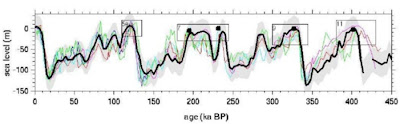
(from: Eustatic sea level during past interglacials)
You recon you can smooth that baby out by controlling carbon emissions? (And if you averaged out the swings, sea level would be maybe fifty meters lower than now...and that means, well, a lot of glaciers up north. Looking at the graph, we seem to be near a peak.)
Before the next conference on global warming, I want everyone present to take a deep breath and say: ‘Nature is always changing. We can’t keep nature from changing. I accept that Nature changes. I am happy to be a part of Nature. I am happy to meet any and all changes whatever they may be. I will do my best not to be an asshole to the other lifeforms on this planet.(repeat last sentence two more times)’
Sea level has never been constant. To whine about it is kind of dumb. To say that if we control co2 emissions then sea level and weather will be stable is even more dumb.
Nature has never been stable because she is evolving. So are we. She's not about a steady state, fixed stars, Dantian reality micromanaged into the dust. She's out there on the edge. Honest and clean. Taking reality as it comes.
I'm happy to live with that.
Are you?
I say the number one problem is the borg.
We need to face the borg. Inject it with an appreciation it now lacks. Or kill it if it can't be turned to serve earth-life.
 But (when the seas rise and storms come and weather patterns change) civilization could fall! (screams from off-stage).
You mean the civilization where whoever has the most money has therefore the power of law and force behind them to kick the shit out of everyone else and do whatever they please? That civilization might fall? Hope so. I’ll gladly throw some banana peels in its path. I’m sick of that one. Earth-life is literally sick of that one.
But real civilization, the one that’s been pushed to the side of late, where thinking, compassionate, mature humans look at the nature of the situation around them, and with their family, friends, and natural extended community, do their best to find ways to live happy, creative, exciting, challenging, non-destructive lives…well that one I think has a long, glorious (bumpy) future ahead of it.
Sorry, but global warming isn’t scaring me. Life is change. Don’t like change? Too bad you weren’t born a rock. Erosion denial.
 But (when the seas rise and storms come and weather patterns change) global warming will change everything! (screams from offstage)
Everything has always been changing. To think that things stay the same is delusional. Weather patterns change. Continents move for godsake. Go with the flow a bit. Please?
We cannot keep sea levels stable, any more than we can stop the tides, or make every day a sunny spring nymphfest. There are seashells in the Rocky Mountains, and not so long ago the Sahara Desert was a pretty nice place to live. This is a planet of change. Check out this graph of sea level changes over the past half a million years or so:

(from: Eustatic sea level during past interglacials)
You recon you can smooth that baby out by controlling carbon emissions? (And if you averaged out the swings, sea level would be maybe fifty meters lower than now...and that means, well, a lot of glaciers up north. Looking at the graph, we seem to be near a peak.)
Before the next conference on global warming, I want everyone present to take a deep breath and say: ‘Nature is always changing. We can’t keep nature from changing. I accept that Nature changes. I am happy to be a part of Nature. I am happy to meet any and all changes whatever they may be. I will do my best not to be an asshole to the other lifeforms on this planet.(repeat last sentence two more times)’
Sea level has never been constant. To whine about it is kind of dumb. To say that if we control co2 emissions then sea level and weather will be stable is even more dumb.
Nature has never been stable because she is evolving. So are we. She's not about a steady state, fixed stars, Dantian reality micromanaged into the dust. She's out there on the edge. Honest and clean. Taking reality as it comes.
I'm happy to live with that.
Are you?
I say the number one problem is the borg.
We need to face the borg. Inject it with an appreciation it now lacks. Or kill it if it can't be turned to serve earth-life.


